Click on a book for further information

If psychology is seriously to address the despair and anguish that increasingly afflict us all, it needs to develop ‘outsight’. It needs to stop looking inside the head of each troubled individual that seeks its help and turn its gaze outwards. The causes of distress are not to be found in faulty or dysfunctional brains, but in the often toxic family circumstances, community settings, the workplace and the wider social world, with all its inequalities, injustices and environmental breakdown. These are the true influences on our wellbeing, argues the Midlands Psychology Group, a collective of counselling, clinical and academic psychologists who continue to find inspiration and guidance from the thinking of David Smail. In this hard-hitting challenge to their own profession, they outline their proposal for a social-materialist psychology – one that is concerned with the influences of our shared, material world and how it shapes everything we think, feel and do. For too long psychology has served the interests of the exploitative economic systems that dictate the lives of so many people in the industrialised world. Instead, it should be placing the values of compassionate solidarity at the heart of all that it does. This book seeks to inspire that shift and equip the profession to question, challenge and even change what it does

The impetus behind Team Of One is many years Penny Priest spent working in mental health services in the NHS. It is a collection of fictionalized accounts of stories and experiences which our non-fiction book, Outsight, published in 2022. Like Outsight, it questions the foundations of the psychological therapies industry. But, stories about the evidence can sometimes be more powerful than the evidence itself.
One of the central characters, Frances Fisher, is oppressed by the public health service she works within. She is often a lone voice challenging the system: ‘Public mental health services are keen to push more and more people through treatment programmes to meet the ever growing demand, and the most fashionable therapy of the moment is Zen Psyonics. As the story unfolds, the problems with Zen Psyonics begin to become apparent. Does it actually work? Might it be dangerous? Can we really change our essential natures? Who benefits most, the patients or the therapists? And what do human beings really need in order to survive the harms and cruelties that the world inflicts upon them?’
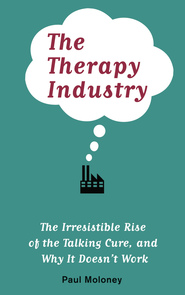
Across the world anxiety, stress and depression are on the increase, a trend which looks set to continue as austerity measures bite. The official response tells people that unhappiness is just a personal problem, rather than a social one.
Written by a practising psychologist, with nearly thirty years’ experience in the fields of mental health and learning disabilities, The Therapy Industry offers a concise, accessible and critical overview of the world of psychological practice in Britain and the USA. Paul Moloney argues that much therapy is geared towards compliance and acceptance of the status quo, rather than attempting to facilitate social change.
The Therapy Industry fundamentally challenges our conceptions of happiness and wellbeing. Moloney argues that therapeutic and applied psychology have little basis in science, that their benefits are highly exaggerated and they prosper because they serve the interests of power.

Contributors include Peter Beresford, Mary Boyle, John Cromby, Jacqui Dillon, Dave Harper, Eleanor Longden, Midlands Psychology group, Joanna Moncrieff, David Pilgrim, Phil Thomas and Jan Wallcraft.
This book contests how both society and Mental Health Services conceptualise and respond to madness. Despite sustained criticisms from academia, survivor groups and practitioners, the bio-genetic model of madness prevails and therefore shapes our very notions of what madness is, who the mad are and how to respond. This dominant yet narrow view, at the heart of the psychiatric system, is misinformed and misleading as well as fraught with tensions between the provision of care and the function of social control. How and why does this system continue? What can be done to change it?
Encompassing both academic analysis and practical application, Madness Contested brings together nurses, service-users, psychiatrists, psychologists, practitioners, and academics who promote alternative ways to understand and approach madness. Their contributions debate questions such as: What are the processes and forms of power involved in the current system? What interests are at play in maintaining dominant theories and practices? What are the alternative conceptualizations of madness? Can practice incorporate openness, modesty and a desire for equality? The perspectives are broad yet complimentary.
Of interest to all those interested in critical debates and alternative models of madness and mental health care, including: academics, practitioners, service users, survivors, carers, students.
Is depression simply the result of chemical imbalances, or Schizophrenia a wholly biological disorder? What role do the broader circumstances of an individual’s social, cultural and heuristic world play in the wider scheme of their psychological wellbeing?
In this ground-breaking and highly innovative text, Cromby et al deliver an introduction to the the biopsychosocial paradigm for understanding and treating psychological distress, taking into consideration the wider contexts that engender the onset of mental illness and critiquing the limitations in the sole use of the biomedical model in psychological practice. Rather than biologically determined or clinically measurable, readers are encouraged to consider mental illness as a subjective experience that is expressed according to the individual experiences of the sufferer rather than the rigidity of diagnostic categories. Similarly, approaches to recovery expand beyond psychiatric medication to consider the fundamental function of methods such as psychotherapy, community psychology and service-user movements in the recovery process. Offering a holistic account of the experience of psychological distress, this text draws upon not only statistical evidence but places an integral emphasis on the service-user experience; anecdotal accounts of which feature throughout in order to provide readers with the perspective of the mental health sufferer.
Taking an integrative approach to the psychology of mental health, the authors draw from a wealth of experience, examples and approaches to present this student-friendly and engaging text. This is core reading for anyone serious about understanding mental health issues and is suitable for undergraduate students taking introductory courses in psychology and abnormal psychology.
 Midlands Psychology Group