In the latest issue of Asylum magazine, our colleague and friend, clinical psychologist Guy Holmes, shares his experience of being made ill by the very same system which is supposed to help those in distress.
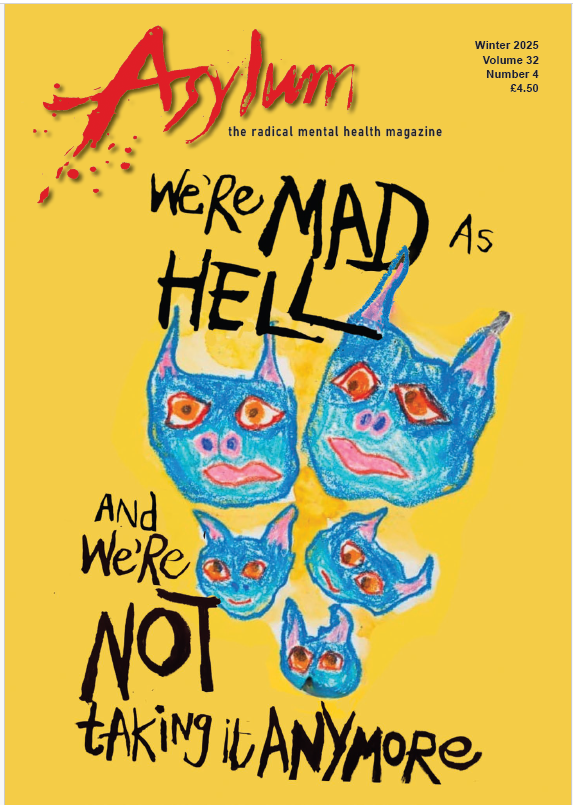
In the latest issue of Asylum magazine, our colleague and friend, clinical psychologist Guy Holmes, shares his experience of being made ill by the very same system which is supposed to help those in distress.
Here’s a blast from the past – from the West Midlands Critical and Community Psychology Conference in Birmingham in 2003. It’s a reminder that ‘for you [psychologists] to help people, you’ve got to understand them, and to understand them you’ve got to know where they’re coming from.’ https://midpsy.uk/wp-content/uploads/2025/11/mike-fox-and-the-poverty-tourists.pdf
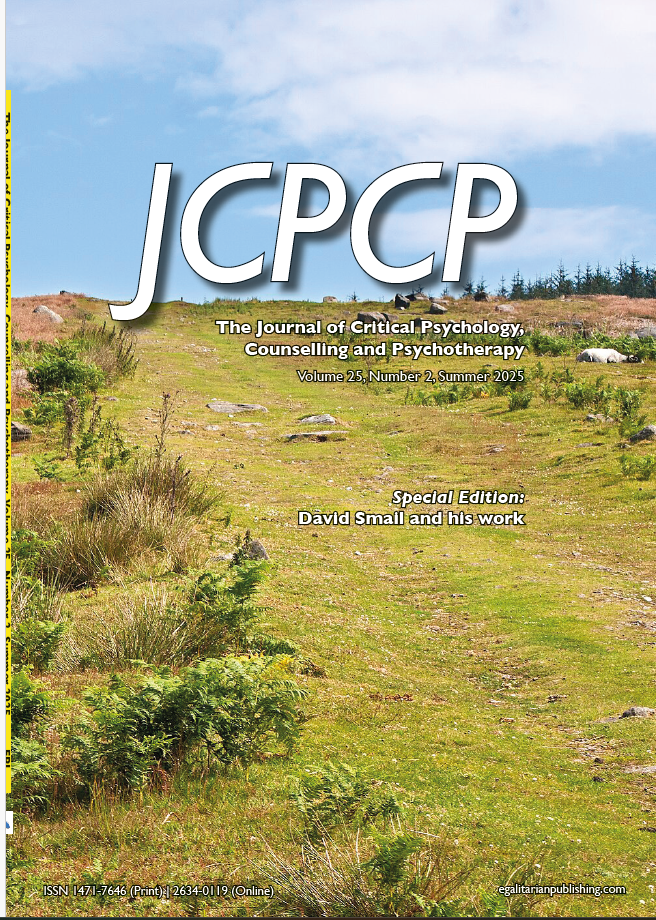
One of the papers in our recent special issue of the Journal of Critical Psychology, Counselling and Psychotherapy, about the legacy of David Smail, is the piece by Penny Priest. Her paper, The Many Problems with Zen Psyonics, includes selected extracts from her recently published
novel, Team Of One, to illustrate David Smail’s critique of the profession of clinical psychology and the need for a social materialist psychology. Reflecting on implications for clinical practice, David warned about a future we are living through today. He also argued the need for: recognizing the limits of psychological therapy; outsight over insight; the importance of including society; and de-psychologization.

More than ten years have passed since David’s death and we miss him dearly.
What would he have made of these times? A world coming apart at the seams following more than 40 years of the neo-liberal consensus. A nominal Labour government assiduously prolonging the harmful ‘austerity’ policies of the previous Conservative government. The main schools of psychotherapy and counselling in the UK are more popular in health-policy circles than ever and as riddled with make-believe as they were in David’s time.
Now seems like a fruitful time to take stock of David’s influence in our own lives and work, and to invite younger psychologists, in the early phases of their careers, to share their thoughts on the meaning of his writings for their own practice in these turbulent times. In collaboration with the Journal of Critical Psychology, Counselling and Psychotherapy we have put together a special edition. The nine papers are a tribute to David, and to the enduring importance of his legacy: not just for psychology, but for anyone who wants to understand life as it is, and to live with a measure of courage and hope.
See page 27 of this month’s Asylum Magazine for Paul Moloney’s review of The Black Dogs of Glaslyn, by our friend and former colleague, Guy Holmes. As explained in the background, Guy worked as a clinical psychologist in the NHS for over 25 years. During that time he published three books in collaboration with service users. He retired from clinical work a decade ago, due to severe mental and physical health problems brought on by work stress, in an environment decimated by austerity. Guy continues to be involved with some Psychology in the Real World groups and raises money for groups and organisations to provide free mental health care. The Black Dogs of Glaslyn is his first novel, influenced by his own and others’ experiences of distress, in a world where there is far too much cruelty.
Asylum, the radical mental health magazine, has been running for nearly 40 years, acting as a platform to voice and discuss all perspectives on mental health. Asylum is a not-for-profit magazine run by volunteers, and supported by PCCS Books. It makes no money from sales of the magazine. It offers free back issues on its website and is grateful to any donations to help continue its work.
https://midpsy.uk/wp-content/uploads/2025/09/asylum-323-digital.pdf
For further info: http://www.asylummagazine.org
Clinical Psychologist, Jim Orford, has just published this book, which aims to answer the question, from a psychological perspective, of how economic inequality is tolerated. He asks why we are putting up with such high levels of income and wealth inequality? It’s also OPEN ACCESS, so free to everyone!
Six Reasons Why We Are Failing to Challenge Great Inequalities of Income and Wealthhttps://link.springer.com/book/10.1007/978-3-031-85564-1
The Midlands Psychology Group are pleased to announce the translation of their Manifesto for a Social Materialist Psychology into Italian.
Psychologist and activist, Livia Lepetit, became interested in the work of David Smail whilst in London in 2019. Keen to disseminate critical thinking on mental health, as well as strengthening networks of likeminded groups and people around Italy, she worked on the Manifesto together with Enrico Valtellina and Luca Negrogno, two sociologists that work independently on mental health, disability studies and peer support.
They have already received comments of appreciation and we will all be interested to see the reception of the Manifesto in Italy.
What are service evaluations actually for?
This month Clinical Psychology Forum, the UK profession’s in-house journal, published ‘a service evaluation of a dialectical behavioural therapy-informed skills group for community mental health service users with complex emotional needs’. The authors’ rationale, in the context of staff shortages, burnout, recruitment difficulties, long waiting lists and limited funding, was that DBT-informed skills group (DBTi-S) can ‘treat multiple clients simultaneously and its minimal, low-cost training requirements for staff’. Whilst their results showed a significant reduction in dysfunctional coping and blaming others (as measured by the Dialectical Behaviour Therapy Ways of Coping Checklist (DBT-WCCL), there were no significant results from the Warwick-Edinburgh Mental Wellbeing Scale (WEMWBS), the Work and Social Adjustment Scale (WSAS) nor the Difficulties in Emotion Regulation Scale (DERS).
As is so often the case with research into the effectiveness of psychological therapies, this service evaluation is replete with methodological problems, not least with self-report as a way of assessing outcomes, including: the unreliability of introspection and memory; participant reactivity; (i.e. response/behaviour change due to being aware of being observed); response bias (e.g. responding according to social desirability); demand characteristics (e.g. picking up information regarding what the study is looking for) (see Rust & Golombok, 1999).
More importantly perhaps, the paper also seemed to gloss over the fact that there was a 62.5% drop out rate: 24 service users across three CMHTs were accepted to attend DBTi-S groups, however only NINE of them completed the six-month programme. Interestingly, their qualitative data included the feedback that ‘three patients expressed a preference for smaller group numbers as it provided more opportunities to learn and practice the skills’. This seemed to be reported as something positive, and yet this was said by only three of the nine people who completed the programme (so 12.5% of the original cohort). With the groups running across three CMHTs, this must have meant that on average each group had 3 people in attendance.
It’s maybe also worth noting that the groups were delivered by at least two trained facilitators – Assistant Psychologists, CMHT Keyworkers and Associate Psychological Practitioners who had done the DBT Essentials training, that is, a 2 day introductory workshop.
They conclude that ‘Overall, the continuation of this intervention is likely to prove beneficial to its participants and the Trust.’
We should be surprised at this conclusion, on the basis of the limited outcomes and the drop-out rate. But it’s not surprising. This is happening all over the UK and precisely one of the reasons for our books, Team Of One and Outsight.
Is this really the best that clinical psychology has to offer?
Power, Interest and Psychology: Elements of a Social Materialist Understanding of Distress, by David Smail, was published twenty years ago this month. It started life as an internet publication, Power, Responsibility and Freedom. David was attracted by the possibilities the internet afforded, of being freed from the constraints of profit and copyright, and also that the text could be interactive, and respond to the views of readers. Ultimately, he decided that the medium did not generate as much dialogue as he had hoped, and there were other drawbacks such as demands for constant updates. He therefore resorted to the hard copy, Power, Interest and Psychology.
The central argument of the book is that human conduct, and in particular psychological and emotional distress, cannot be understood by an analysis of individual will, intention or cognition. Conventional therapeutic psychology suggests that we are essentially self-creating and able (with a little help from a therapist) to heal ourselves of the emotional ills that beset us. This kind of view reflects the wishful thinking and make-believe that are necessary for the success of modern consumer capitalism, but it does not reflect the way things are. The alternative set out in the book, explains how our experience of ourselves as well as much of our conduct is accounted for in terms of the social operation of power and interest. A framework is established for making sense of our emotional distress as the outcome of environmental pressures.
Powerful blog by John Cromby dismantling the arguments for the benefits cuts. A timely counter to recent troll attempts to claim that critcs of psychiatry are supporting and facilitating the government’s actions. The best way forward is tackling the poverty and inequality that drives people to despair in the first place – not depriving them of their means of survival.

 Midlands Psychology Group